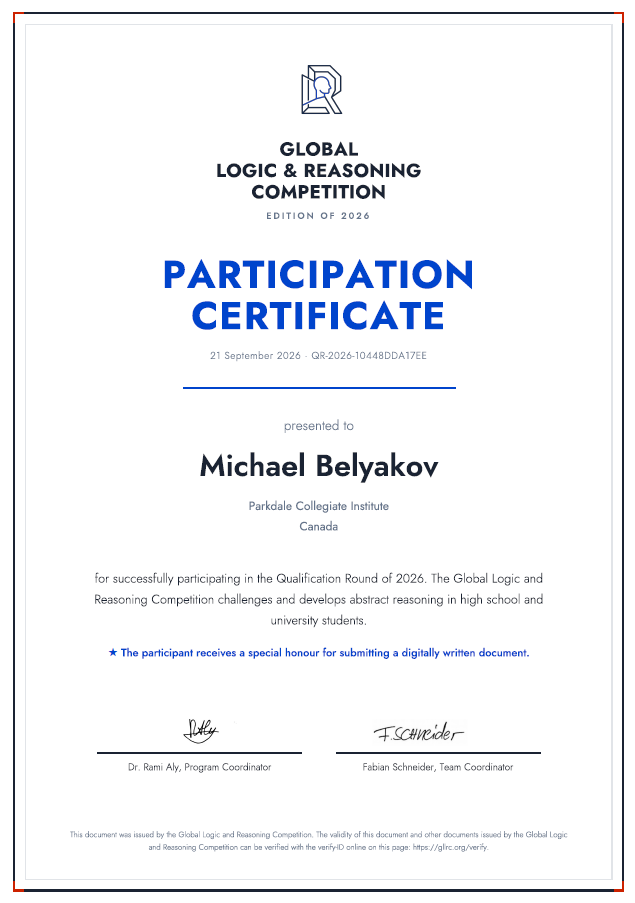
I am excited to share that I completed the Qualification Round of the 2026 Global Logic and Reasoning Competition. I solved enough problems correctly to qualify for the upcoming Semi-Final Round, where I will compete with students worldwide.
This competition differs from many school contests because there is no syllabus to memorize. Instead of testing what I have been taught, it tests how I think. In a world where artificial intelligence can provide information instantly, good judgment, careful reasoning, and the ability to ask the right questions are more important than ever.
Why reasoning matters in the age of AI
Today, information is everywhere. We can search online, watch videos, use AI tools, and find answers in seconds. However, having information is not the same as understanding it.
We still need to decide:
Is this information reliable?
Does the evidence actually support the conclusion?
What might be missing?
Is something likely to happen, or is it guaranteed?
Could two events be connected without one causing the other?
The competition challenges students to think independently instead of accepting the first answer that sounds convincing. I enjoy this because every question feels like a puzzle. It pushes me to slow down, recognize patterns, test ideas, and explain why an answer makes sense.
The six domains of reasoning
The competition tests six different types of reasoning. Each one is useful not only in competitions, but also in school, everyday decisions, science, technology, and future careers.
1. Deductive reasoning: “What must be true?”
Deductive reasoning starts with facts or rules and asks what conclusion must follow.
For example, if all students in a club must attend meetings, and Maya is in the club, then Maya must attend meetings. The answer is certain because it follows directly from the rule.
This type of thinking helps with logic puzzles, mathematics, computer programming, and making careful arguments.
2. Probabilistic reasoning: “What is likely to be true?”
Sometimes we cannot know something with complete certainty. Instead, we need to think about what is most likely based on the available evidence.
For example, if dark clouds appear and the weather forecast predicts rain, it is reasonable to bring an umbrella. It does not guarantee rain, but it is a sensible decision based on probability.
This kind of reasoning is important because real life often involves uncertainty. We need to be open to new evidence and willing to change our minds when the facts change.
3. Causal reasoning: “What causes what?”
Causal reasoning is about understanding whether one thing actually causes another. Just because two events happen at the same time does not mean that one caused the other.
For instance, ice cream sales and sunburn cases may both increase during summer. Ice cream does not cause sunburn. The real factor is warmer, sunnier weather.
This skill helps us avoid jumping to conclusions. It is useful in science, news reporting, health research, and public policy decisions.
4. Strategic reasoning: “What should I do when others are thinking too?”
Strategic reasoning matters when the outcome depends on other people's choices, not just our own.
It can happen in games, sports, negotiations, business, and even group projects. You may need to predict what someone else is likely to do and then choose the best response.
For example, in chess, which I also play, it is not enough to think only about your next move. You also need to consider how your opponent may respond.
5. Critical reading: “Is this argument sound?”
Critical reading means looking beyond persuasive words and checking whether an argument is actually supported by evidence.
A statement can sound confident and still have weak logic, missing facts, or hidden assumptions. Learning to recognize these gaps matters especially online, where misleading headlines and opinions can spread quickly.
This skill helps me read articles more carefully, evaluate sources, and form my own opinions based on evidence rather than popularity.
6. Modelling and estimation: “How do I structure this messy problem?”
Not every problem has enough data or a simple answer. Modelling and estimation involve breaking a complicated question into smaller, more manageable parts and then making a reasonable estimate.
For example, if someone asks how AI might affect jobs in the future, there may not be one exact answer. We need to consider different types of work, the speed of technological change, education, laws, and how people and businesses adapt.
This type of reasoning teaches us to make sensible decisions even with incomplete information.
Looking ahead
The competition has shown me that reasoning is not only about getting the correct answer. It is also about being curious, questioning assumptions, learning from mistakes, and explaining my thinking.
As AI becomes more powerful, human judgment will become even more valuable. AI can provide information, but people still need to decide what to trust, what matters, and what to do.
I am looking forward to the 2026 Semi-Final Round and the opportunity to challenge myself alongside students from around the world.